Sunday, July 20, 2008

Quick Pickles


I ended up having a glut of onions and cucumbers last week, thanks in part to a miscommunication with sous-chef Peter, who is responsible for ingredient sourcing each week at Ofuna market. Since daytime temperatures are hovering above the 30 degree mark in my kitchen, and I'm dealing with a ridiculously small bar fridge, something had to be done. I got this idea from the cucumber thread over at eGullet.org.

My mother used to make cucumber pickles every year, along with jam, jellies, relishes and chutneys. When I mention to my Japanese friends that I make tsukemono (Japanese-style pickles), they're often surprised that a foreigner a) knows how to make them, and b) enjoys eating them. When I mention I grew up on home-made pickles, albeit of a different style, their eyes really bug out. Unlike my mother, however, I don't have an array of canning equipment and a large basement to store things in, so I'm limiting myself to quick pickles - lightly salted vegetables, kept in the fridge in a sweet vinegar bath. I think it's a fast way to use up a glut, and they're a great addition to my lunch box.

If you'd like to play along, just slice some onions and cucumbers, then toss them in a few spoons of coarse salt. Put them in a bowl with a weight on them - like another bowl filled with water, for example. In fifteen or twenty minutes, rinse them off, and squeeze out any extra liquid, and put them into a non-reactive container, like a glass jar or tupperware. In a pot, dissolve sugar in vinegar in a 1:1 ratio - I used 2/3 cup rice vinegar to 2/3 cup white sugar. When the sugar has fully dissolved, pour the liquid over your cucumbers and onions, cover and refrigerate. Add garlic or dill, if you like. Or not. They should keep for about a week, but we're eating them so fast, they're hardly making it that long.

Sunday, July 13, 2008

Salt and Pepper Tuna Onigiri


These past few weeks have been quite hectic for me, with increased class loads. That, coupled with the onset of the hot weather here, has meant dinners are getting lighter around my place, and there aren't so many leftovers to remake for lunch the next day.

When my day gets busy, and I need something quick and reasonably healthy to eat, I often resort to that great Japanese convenience store stand-by - the tuna mayonnaise onigiri. But I get bored if I have to eat the same thing over and over, so I took a look around my kitchen to see how I could jazz them up.

I don't usually keep nori on hand, since Peter hates it so much, but it really provides a satisfying crunch and saltiness that I knew would be missing without it. My solution: gomashio - salted sesame seeds. I was following Maki's directions for making gomashio over on Just Bento when I realized that I didn't have quite enough black sesame seeds on hand to make as much as I liked, so I used a mix of white and black seeds. Then, staring at the mix in the pan, I thought - "Hey - this looks like salt and pepper!" So in the pan went some freshly ground black pepper.

The next morning, I mixed up some tuna salad, just as I would normally (with Kewpie mayonnaise, of course). Instead of putting it between a couple of slices of white bread, as I would have in Canada, however, I made onigiri. Rice balls can easily be made by hand, but since I was taking my first crack at putting something inside them, I wanted to use something for a mold.


First up, I took my two cups of warm rice, and added a generous sprinkling of gomashio - maybe a tablespoon or so. I mixed it so the seeds were nicely distributed, and then lined a small ramekin with plastic wrap. I dolloped in some rice, pressed it around, and then made an indentation in the centre. There, I added about 2 tsp. of tuna salad, and then topped the lot with more rice, pressing around the edges to get a good seal around the filling. I then lifted the lot out using the plastic wrap, and wrapped it up as if it were a regular sandwich. I made three filled onigiri for myself, and one plain for Peter out of the two cups of rice, and still had some tuna salad left over. This along with some cherry tomatoes and a miso soup bomb, made for a frugal lunch that I ate with one hand (the other hand, of course, busily cutting up flash cards, as ever.)

Sunday, June 29, 2008

Nikko and Shojin Ryori

After an incredibly busy few weeks at work, it was a relief to get some time off, and take our first trip out of the city since the fall. We took a train to Nikko, a world heritage site and national park, home of the Toshogu Shrine.


The town is beautiful, and at this time of year, incredibly quiet. Although the mountains were shrouded in mist and low clouds during our stay, the cedar trees that peeked out from time to time were a breathtaking enough sight. We stayed at the Nikko Park Lodge, a cosy and relaxed hostel with a selection of Spanish red wine and a huge music DVD collection - it was like visiting my parents! The cook at work in the kitchen, Nagisa, was clearly proud of the food in the hostel, and justifiably so. Hostel food doesn't have to be great as guests usually don't have much choice, and especially considering most of the sleepy town shuts down permanently at 8pm. The Lodge, however, along with offering some vegetarian a la carte dishes, and sturdy breakfasts perfect for trekking through the shrines and other sites, offers a vegan set menu styled on the traditional vegetarian cuisine of Buddhist monks, shojin ryori.


The set included an individual pot for each diner, filled with shiitake, enoki, maitake, and bunashimeji mushrooms. The mushrooms simmered over a flame in a light broth, along with some yuba, a specialty of Nikko. Yuba is the skin that forms on soy milk, as it is curdled to make tofu. It doesn't sound particularly appetizing to the western palate, but Peter pronounced it delicious, likening it a sweet-tasting cheese curd. My mission to convert Peter to a tofu lover continues apace. He had been quite hesitant about the idea of a vegan dinner, but the large pot of mushrooms won him over almost immediately, and he happily addressed the rest of the meal, which included a tofu "steak"; a slice of firm tofu that had been fried in a soy-ginger glaze; a pot of vegetable miso soup, with carrots and sato imo - a sort of hard-to-describe wild potato with a silky soft texture and potato-y taste; and a large tub of mixed-grain rice.


The whole meal was presented beautifully, in typical Japanese style, and I could barely push myself away from the table at the end of it, I was so full. It was a real treat to try this sort of cuisine, and I look forward to sampling more of it in the future.


There was so much to see in Nikko - we spent two days chasing waterfall views, racing the clouds for visibility- and between the shrines and the natural beauty of the mountains, we kept busy. We dodged school trip delegations from site to site, and, it seemed, had the whole place to ourselves at times. We met our friends, Niamh and Avinder, on the second night and had dinner at the popular Hippari Dako yakitori shop, which has a large international following by the looks of the business cards on the walls. Impassioned testimonials from past visitors thanking the proprietress for her vegetarian offerings gave a clue to the reasons for her popularity amongst the young Eurpoean set; and frankly I have to give her snaps for making them available - who goes to a yakitoriya looking for a vegetarian meal? Not that vegetables aren't usually available, but...her flexibility does her credit, I guess, and probably makes it a lot easier to stay open during the low season. That aside, her tsukune (chicken meatballs) and hot sake were just the thing after a cold, wet day in the rain, staring at misty voids where waterfalls should be. It doesn't get much more zen than that.

Wednesday, June 25, 2008

Taco Rice

The first time I came across kits for this dish, I was intrigued. Tacos...and....rice? Together? Genius.

Of course, I'm talking white rice here, Japanese style, short grain rice. And taco mix. Like, Old El Paso taco mix. This is Japanese food? Well, technically, it's Okinawan food, and it's clear to see why everyone lives so long on that island, which such lovely food to eat all the time. Wikipedia has some things to say about the provenance of this dish, and it should come as no surprise to anyone who has lived in Northeast Asia that the American military had an influence in its creation. (Remind me to tell you about budaechigae some time.)

It's a pretty simple dish to make yourself: get an Old El Paso taco mix pack, and cook up some ground beef following the instructions there. Or, if you're like me and can't afford the 700 yen/pack, you buy come cumin, chili powder, and a bag of corn chips and make do. I fry about 250g of ground beef with a tablespoon each of cumin and chili powder, plus a crushed garlic clove and salt and pepper. I layer this, salsa, shredded (iceberg, of course) lettuce, and grated cheese all over a plate of cooked rice. Then, I daringly sprinkle crushed corn chips around the perimeter to finish it off.

To gild the lily: if you're super lucky like me, and your clever husband has brought home a bag of overripe avocados that he got for the ridiculously low price of 150 yen, you make some guacamole, too. My guacamole was a bit of a legend in Incheon, South Korea, where it was possible that I was the lone person in a city of 3 million people who knew how to make it. Well, Jo liked it, anyway. My guac is super easy to make - I squash as many avocados as I can afford, with copious salt, lime juice, a bit of crushed garlic, diced red onion, and a pinch of cumin. I have no idea how authentic that is (probably wildly in-, I expect), but since it's unlikely I'll ever serve it to someone who actually does know what it's supposed to taste like, I serve it with confidence.


I made a double portion of everything, and had enough for bentos the next day.

Monday, June 23, 2008

Stuffed Zucchini on a Japanese Gas Range

Peter came home on the weekend with a big bag full of zucchinis and cucumbers that he got a Ofuna market. Yes, it's that time of year again - time to wonder what the @&*% to do with all the zucchini.

In my opinion, it's best to deal with them when they're small, otherwise they breed exponentially, and you find yourself in a weeping pile in the middle of the kitchen, having made zucchini bread, zucchini muffins, zucchini stir-fry; zucchini pickle and having grated zucchini into spaghetti sauce, oatmeal, and finally, in a desperate bid to finish it off, directly into the toilet. It rather reminds me of the time I bought the biggest daikon I could find, and was still making things out of it a week later.

I have no idea what the Japanese do with zucchinis, so I thought back to how I like to eat zucchinis in Canada. All I could remember was roast zucchini, which seemed hard to manage in my oven-less kitchen. One reason why I started learning to cook Japanese dishes was that I'm limited by my gas range - it seems most of the dishes I grew up on rely on having an oven to bake or roast ingredients. (This usually takes longer, but does leave the cook free to wander off and put the wash on or play a short round of Mario Party. ) One dish I really loved in Canada was stuffed eggplant, in which big eggplants are stuffed with ground chicken, breadcrumbs, and herbs, and topped with cheese and grilled in the oven. I though with a little re-engineering, I could make this with zucchini on a gas range. Thus, I give you Erin's Stuffed Zucchini (on a gas range)

Step 1: Sternly deal with Zucchinis


There is always too much zucchini. It's a fact of life. Although Peter brought home only four small zucchinis, I knew it would be too many. I set two aside to be cut up and frozen. The remaining two were lumpy and bumpy and irregularly shaped, like most natural things, so I cut them down to smallish boat-like shapes. The long skinny top bits I sliced thinly and set aside for a side dish for the next day. Then, addressing the boats, I hollowed them out with a knife and spoon, and finely chopped the scooped-out guts. I put them into a bowl to form part of the stuffing. In a pan, I heated some olive oil, maybe a tablespoon or so, and salted and peppered the boats. When the oil was hot, I lay the boats in the pan, hollow-side down, covered them up, and put the heat to medium low.

Step 2: Stuffing Logs
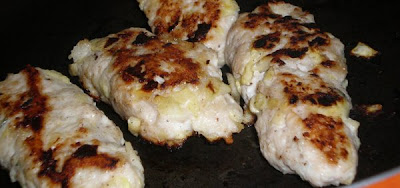

While the boats sizzled, I added about 200 g of ground chicken to the boat-guts (sorry, but boat is so much easier to type than zucchini), along with two tablespoons of breadcrumbs (panko for me, but any kind would do), a crushed clove of garlic, some fresh thyme I had off my thyme plant, and generous salt and pepper. I squashed this all around until it was evenly mixed. At this point, I checked on the boats, and flipped them. They were nicely browned on one side. Going back to the stuffing, I formed it into four flattish sausages, and set them aside. A few minutes later, the boats were nicely limp, so I took them out of the pan, and added the sausages. I pan fried them for about five minutes on each side, until they were cooked through. Then I plopped them into the boat hollows, judging to see which hollow matched which sausage best. Then I transferred the lot of them to my fish grill.

Step 3: Up in My Grill


When the stuffed boats were together, I put them onto my fish grill, and topped them with grated cheese. I had white cheddar, but parmesan or gruyere would be grand as well. Even regular 7/11 pizza cheese would do in a pinch. Then I fired them under the grill for about 5 minutes (while I queued up the next episode of Lost on my computer), and served them up for dinner with some crusty bread. This makes a very light dinner, so I recommend some sort of side - salad, baked potatoes, rice....as you like.

As for the rest of the zucchini, since my pan was already dirty, and I had already sliced them up, I popped the slices into the frying pan with some sesame oil, salt, and Korean chili powder. One strategy I try to employ to cut down on my time in the kitchen is to always try to think of two dishes I can make out of one prep session. Prep once; eat twice, and all of that. When they were limp, I put them into a plastic container for the next day's dinner.

Two zucchinis down; two to go.